VLA Training
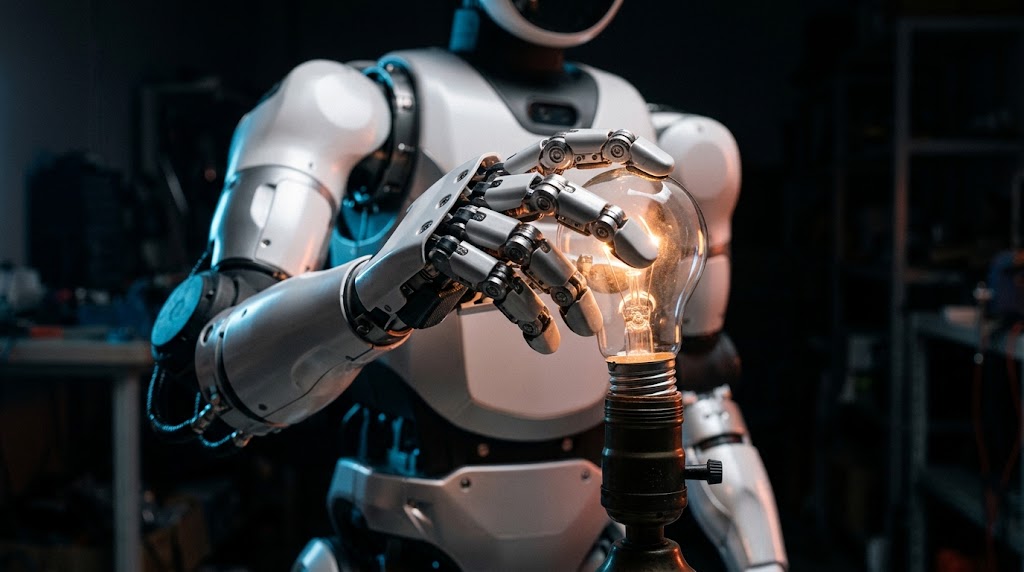
Training vision-language-action models on teleoperated demos — like a G1 screwing in a lightbulb.
- VLA
- Imitation Learning
- Manipulation
Overview
Vision-language-action (VLA) models let a robot take a camera image and an instruction — "screw in the lightbulb" — and output actions directly.
We fine-tuned a VLA on demonstrations collected with our teleoperation system, teaching a Unitree G1 with a dexterous hand to perform fine manipulation tasks.
The Challenge
Screwing in a lightbulb needs precise finger control, constant small corrections and awareness of when the bulb is seated.
Good VLA performance depends heavily on the quality and consistency of demonstrations.
Our Approach
Collected and curated a dataset of teleoperated demonstrations with synchronized cameras and joint states.
Fine-tuned an open VLA backbone on the dataset, with careful action chunking and normalization.
Evaluated on the real robot with varied bulb positions and lighting, feeding failures back into data collection.
Results
- The robot completes the lightbulb task from new start positions (placeholder — add success rate)
- A repeatable data → training → evaluation pipeline for new manipulation tasks
Tech Stack
- Unitree G1
- Dexterous hand
- PyTorch
- LeRobot
- Hugging Face
- ROS 2